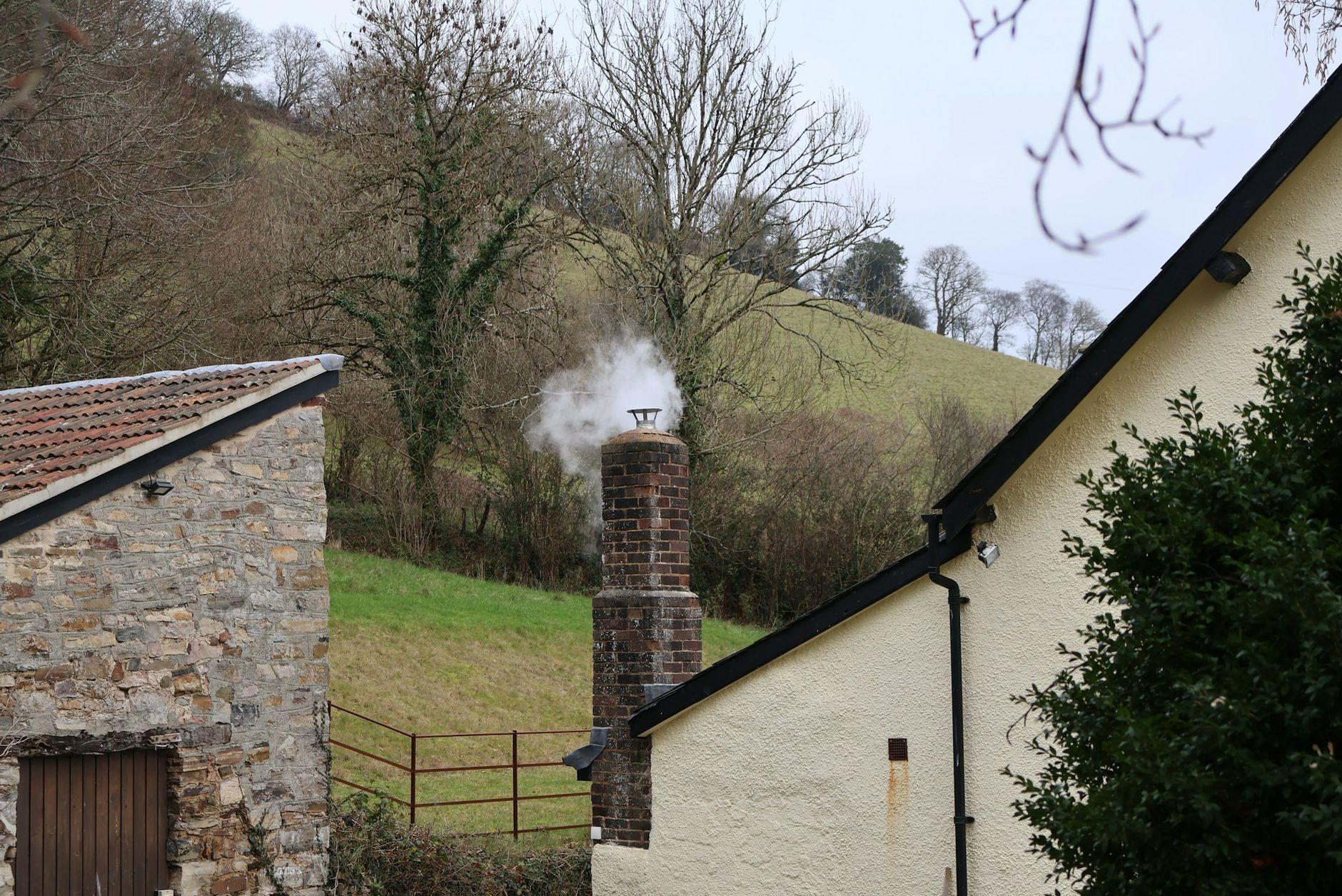
Brick chimneys built in Brea before the 1960s were, in most cases, laid without any steel inside them. The bricks rely on mortar and their own weight to stay put. That holds up through decades of wind and rain. It holds up far less well when the ground moves sideways, because an unreinforced stack has nothing tying it to the house once the mortar lets go.
How older chimneys break when the ground shakes
Damage tends to follow a pattern. The section above the roof whips back and forth and snaps near the roofline, where the stiff roof framing holds the brick below and leaves the brick above free. Upper courses fall onto the roof or into the yard. Lower down, a chimney on an outside wall can lean away from the house, opening a gap at the top that keeps widening. Inside, tile liners shift and crack even when the outside looks fine. Owners across Southern California who went through the 1994 quake saw all three.
Chimneys built later usually had steel bars running up through the masonry and anchors into the framing. Many older houses never got them.
What the work can include
No single retrofit suits every chimney. On an older house the plan usually combines some of these:
- Anchors at the floor and ceiling lines. Steel straps fixed to the house framing and wrapped or bolted around the chimney, so the stack moves with the house instead of against it.
- Bracing above the roof. A steel frame that holds the upper stack back to the roof structure.
- Lowering the stack. Taking the brick down to the roofline or below and finishing with a light metal flue, when the fireplace is no longer burned or is changing to gas.
- Relaying with steel. Building the upper chimney again with reinforcing bar inside, when the old brick is past repair anyway.
Each choice has a cost and a consequence. Lowering removes the most weight but changes how the house looks from the street. Bracing keeps the look but leaves the old brick in place. Relaying is the most work.
Masonry first
Steel fixed to sandy mortar holds onto very little. On older chimneys we check the joints and brick before planning any retrofit, and if the stack needs repointing or partial relaying first, that goes on the estimate ahead of the steel. Our masonry repair page covers that side of it, and the seismic retrofit page covers the steel.
What we look at on the visit
A seismic assessment on an older house starts on the roof and ends in the rooms below. On top, we measure how far the stack rises above the roofline, press on the upper courses, and look for a crack line or a shifted course at the point where the roof meets the brick. In the attic we look for any existing anchors, the size and direction of the joists beside the chimney, and the gap between brick and framing. Inside, we check the firebox and the face for cracks that line up with what we saw outside. Where there is a crawl space, the footing of the chimney gets a look from below as well.
Keeping the look of an older house
Owners of Craftsman and Spanish houses often worry that steel will spoil the chimney. Most of the hardware sits in the attic, behind the roofing or on the back face of the stack, and above-roof bracing can be painted to suit. Where the stack is lowered, it can be finished with a short brick cap over the metal flue so the roofline still reads as a chimney from the street. The estimate describes what will show once the work is done.
What decides the price
Seismic work has no published price on this site. The figure depends on how tall the stack rises above the roof, the condition of the brick, whether the chimney sits on an outside wall or rises through the middle of the house, how many floors it passes, and which mix of the options above fits. A Level 2 inspection at $385 is often where planning starts, because it shows whether the liner has already cracked, and that changes the plan.
For a written plan on your own chimney, request a seismic assessment and tell us whether the fireplace still gets used and which wall of the house the chimney stands on. Our written estimate puts each option on its own line.
Why older houses near Brea deserve the attention
Brea lies close to the Whittier fault, and La Mirada, Buena Park and Anaheim share the same shaking risk. Chimneys here have already been through the 1987 Whittier Narrows earthquake and the 1994 quake. Some came through intact; others carry cracks at the roofline that nobody has checked since. A chimney does not have to have fallen to have been weakened.
Questions owners ask
Will bracing stop the chimney from cracking? It is meant to keep the stack from falling, not to keep it from cracking. That difference is why the state of the brick matters so much.
Is it better to remove the chimney? If the fireplace is never used, lowering the stack is often the cheapest way to take the weight away. If you burn wood, removal means giving up the fireplace or changing to a vented gas unit.
Does a retrofit need a permit? Structural chimney work often does, and the estimate says whether one applies to yours.
Can it be done during a sale? Yes, and the up-to-code repairs page explains how repair estimates fit into a transaction.
For a look at an unreinforced chimney on an older house, our contact page puts a visit on the calendar.
An Older Chimney of Your Own?
Gilchrist looks after chimneys and fireplaces on older houses, with a written price for every repair and the original masonry kept where it is safe. Visits run from Brea to La Mirada, Buena Park, Anaheim and the cities nearby.